Fun Synonyms Activities with Pictures and Boom Cards
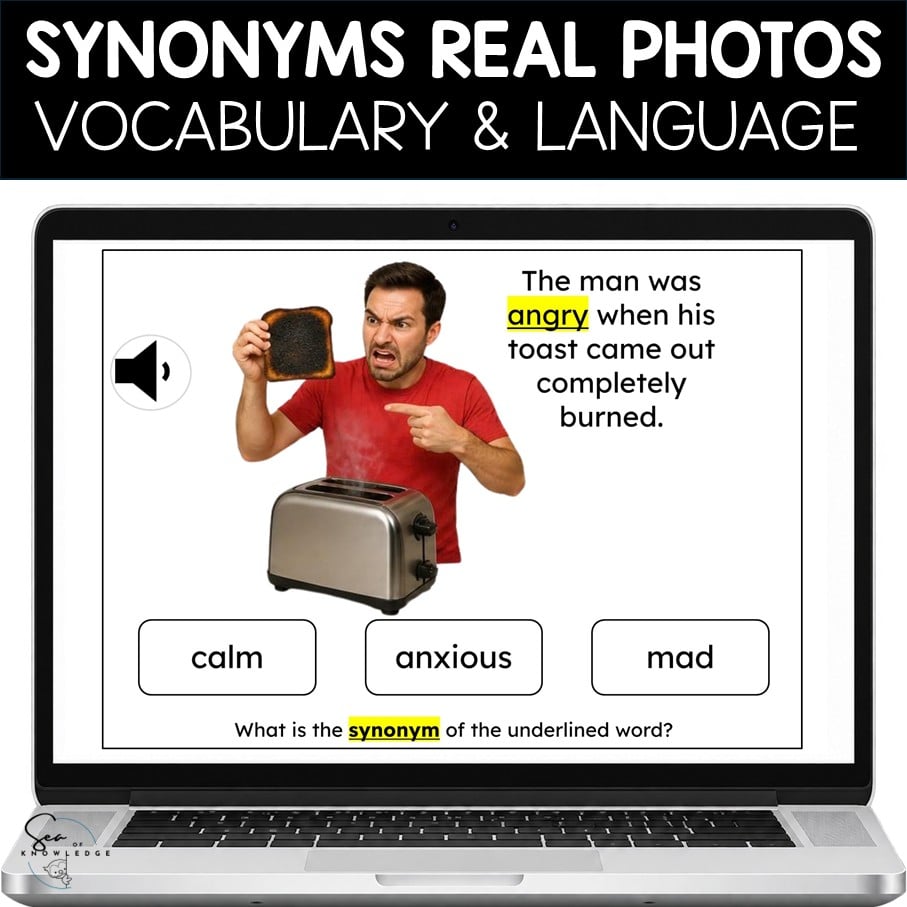
Looking for synonyms activities that get students thinking about word meanings? Sometimes a funny picture is exactly what a vocabulary lesson needs. A man holding burned toast certainly gives us something to talk about. Breakfast has gone wrong, but our word work is looking promising!
These synonyms Boom Cards combine humorous, realistic pictures with short sentences, audio narration, and multiple-choice questions. Students practice choosing words with the same or nearly the same meaning while using the sentence and visual scene for support. They are a practical option for elementary literacy centers, special education, speech therapy, ESL/ELL instruction, and reading intervention.
What Are Synonyms?
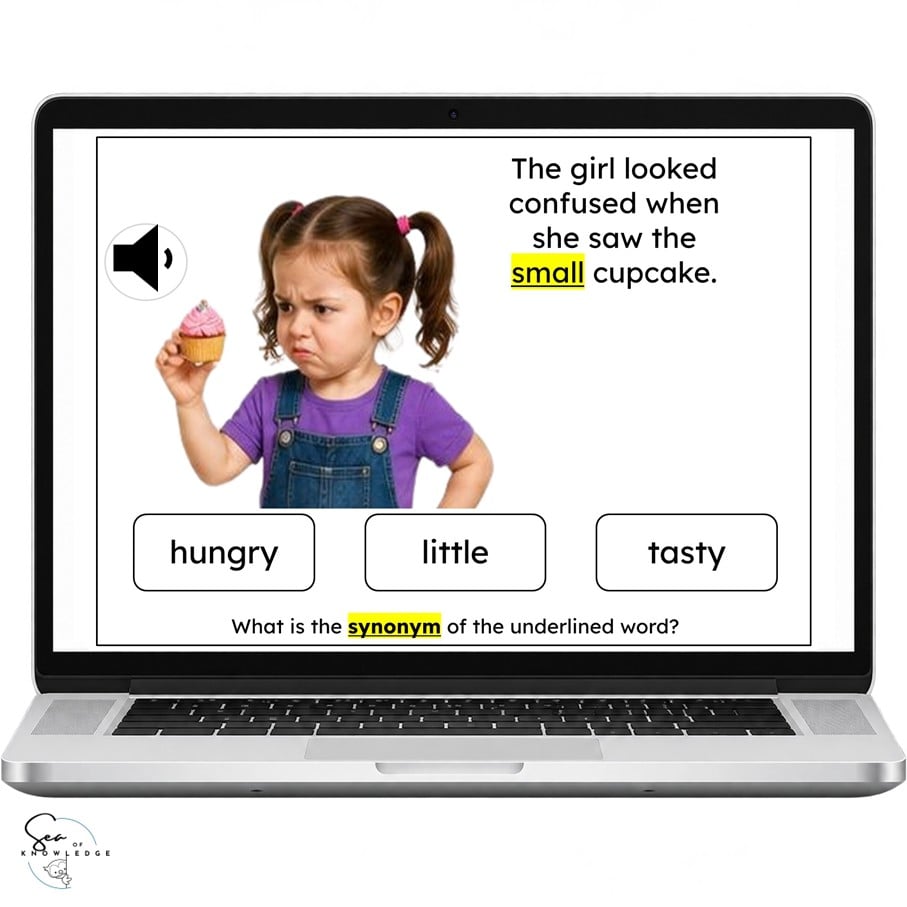
Synonyms are words with the same or nearly the same meaning. For example, small and little can describe the size of a cupcake. Angry and mad can describe how someone feels when their toast burns.
Teaching similar meaning words gives students more ways to understand and express an idea. However, synonyms do not always fit every sentence equally well. Encourage students to check the meaning of the whole sentence rather than simply memorizing a pair of words.
If your learners are still developing basic sentence understanding, start alongside these beginner sentence worksheets. Reading a short sentence, discussing its meaning, and then changing one word makes a manageable next step.
What Is Included in This Synonyms Boom Cards Deck?
This interactive synonyms activity includes 16 self-checking Boom Cards. Each question asks students to read or listen to a sentence, identify the highlighted vocabulary word, and choose its synonym from three possible answers.
- 16 interactive Boom Cards
- Realistic, humorous photo scenes
- Synonym identification within sentence context
- Three multiple-choice answers per question
- Highlighted target vocabulary words
- Audio narration for developing readers
- Immediate feedback through self-checking digital activities
The deck targets vocabulary development, word meanings, context clues, reading comprehension, receptive language, language development, and semantic relationships. The repeated question format also gives students a predictable routine: read or listen, think about the word, and choose an answer.
How to Use These Synonyms Activities
1. Model One Question Together
Begin by explaining that students are looking for a word with a similar meaning. Show the burned-toast example and discuss the man’s expression. Read the sentence aloud or use the audio narration. Then point to angry and compare the three choices: calm, anxious, and mad.
Think aloud: “He feels angry because his toast burned. Mad has a similar meaning here.” Explain why the other choices are less suitable. This turns a multiple-choice vocabulary activity into a short discussion about meaning.
2. Use the Sentence and Picture as Clues
Ask students what is happening before they select an answer. In the cupcake example, the girl is looking at a small cupcake. The choices are hungry, little, and tasty. Hungry and tasty might make students think of food, but little matches the meaning of small.
That distinction matters! A word can be connected to the picture without being a synonym of the target word. These synonyms in context Boom Cards give you an easy way to discuss the difference.
3. Reread With the New Word
After students answer, replace the highlighted word with the synonym and reread the sentence together. Ask whether the meaning stays the same or nearly the same. Follow with a quick oral sentence using the new word.
For a hands-on language extension, try this noun and verb sorting craft. Students can compare what a word means with the job it does in a sentence. Those are different questions, and discussing both helps keep vocabulary and grammar instruction connected.
Using Synonyms Activities in Centers and Small Groups
For literacy centers, demonstrate the task first so students understand what to do. Have learners work independently or with a partner, depending on their reading and language needs. A partner can explain an answer before either student selects it.
In small groups, pause after a few cards to revisit useful word pairs. Ask students to explain a choice, describe the picture, or suggest another similar word. You can also use a short round as a vocabulary warm-up before verb tense bingo, giving students practice with both word meanings and sentence grammar.
Support for Special Education, Speech Therapy, and ESL/ELL
For special education and reading intervention, use the narration when reading the sentence independently would make the vocabulary task too demanding. Begin with a few cards and give students time to process each question.
For speech-language sessions, use the deck as a starting point for receptive language and semantic relationship practice. Move beyond selecting an answer by asking students to explain how the words are related or use a word in a new sentence. Choose prompts that match the learner’s goals.
For ESL/ELL students, review unfamiliar answer choices before expecting independent work. Students may understand the scene while still needing help with the English vocabulary. Pair word-meaning practice with this have and has present tense activity when you want a separate sentence-building task.
You can also keep useful language visible with these ESL grammar bulletin board ideas. For a later lesson on words that name feelings or ideas, explore these abstract noun sentence examples.
Can Boom Cards Engage Learners of Any Age?
Yes! Boom Cards can be a great way to engage learners of any age when the vocabulary, pictures, and task match their needs and interests. Interactive choices, audio support, and immediate feedback can make practice feel more inviting.
This particular deck is designed with elementary learners and vocabulary support in mind. You may also find individual scenes useful with older learners who are working on the same language skills. Choose resources by both skill level and age appropriateness. A funny picture can start a conversation, but the learner’s response should guide your choice.
Add Free Synonyms and Antonyms Worksheets
Want to follow digital practice with a paper activity? These two separate freebies give students another opportunity to work with word relationships:
Use a worksheet after modeling a few digital questions, or save it for a review lesson. Remind students that synonyms have similar meanings, while antonyms have opposite meanings. Ask them to explain a word pair aloud before completing their written response.
If you are planning a wider grammar rotation, add this common and proper nouns lesson plan as another station. It gives you a different language focus while keeping the lesson centered on words and how we use them.
Try These Interactive Synonyms Activities
You do not need a complicated lesson to make vocabulary practice meaningful. Model a question, talk about the scene, compare the choices, and help students use their new words beyond the screen.
Ready to bring a little humor into your next word-meaning lesson? Explore the synonyms and similar meaning words Boom Cards deck and use it for supported practice, literacy centers, or small-group vocabulary work. The toast may be burned, but the lesson is ready to go!


![WH Questions Exercises Using Fun I Spy Picture Scenes [Free Library Scene Set]](https://www.seaofknowledge.org/wp-content/uploads/2026/06/WH-Questions-Exercises-Library-Scene-2.jpg)