Question Words Worksheet: Stop Boring WH Question Practice With This Hidden Picture Game
Stop boring WH-question practice with these funny hidden-picture question words worksheets. Students search, think, and answer who, what, where, when, why, which, and how questions.
If your students can say “who, what, where, when, why” on repeat but then stare blankly at an actual question… yep, you are not alone. A standard question words worksheet can get a little repetitive fast. Children may know that who is for a person and where is for a place, but putting that knowledge into real questions is a whole different ball game.
For extra speaking practice, these WH questions for speech therapy activities are a helpful next step. Students can use the funny hidden-picture scenes to answer questions aloud, point to clues, and practise giving fuller responses.
Tired of boring social skills worksheets that kids rush through without really thinking? This fun Search and Find SEL Book turns kindness, friendship, emotions, empathy, and anti-bullying practice into a hands-on activity kids actually want to complete.
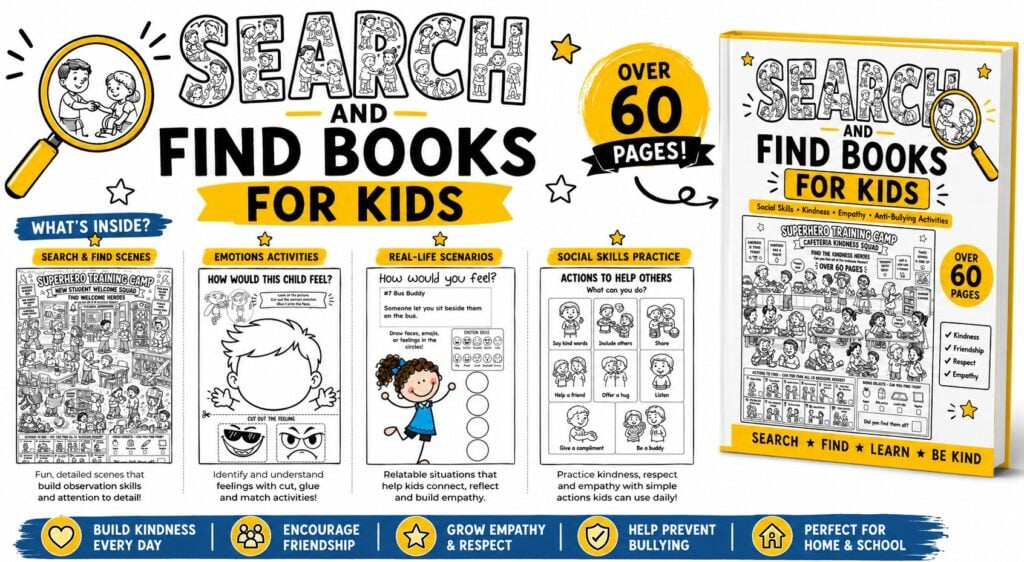
With over 60 pages of busy picture scenes and simple real-life scenarios, it is perfect for helping children build stronger social skills without the eye rolls.
That is why I made these funny hidden-picture scenes. Instead of filling in random sentences, students become little question detectives. They look closely at a busy school or crazy mall scene, find the silly details, choose the missing question word, and answer the question using evidence from the picture.
Much more fun than another worksheet that makes everyone yawn by question number three. 😂
If your students love a little friendly competition, try pairing this printable with a WH questions game for kids. Use the busy scenes as a partner challenge and see who can find and answer each question first.
In this post, I’ll share how to use this free printable activity for early learners, ESL/EAL students, intervention groups, and anyone who needs a more visual way to practise WH questions.
What Are Question Words?
Question words help children ask for different kinds of information. They are sometimes called WH words because many begin with “wh.”
- Who asks about a person.
- What asks about a thing, action, or idea.
- Where asks about a place.
- When asks about time.
- Why asks for a reason.
- Which asks children to choose between options.
- How asks about the way something happens.
For example, a child might see a boy chasing papers through the school hallway. They can answer:
“Who is chasing the papers?”
Or they might see a girl bumping into a chair while reading.
“What is the girl walking into?”
Once students understand the basics, these WH questions exercises give them even more ways to practise choosing the right question word. They are great for reinforcing who, what, where, when, why, which, and how without making it feel like the longest worksheet in human history.
This simple visual connection is what makes question words for kids much easier to understand. They are not just memorising a list. They can actually see what the question is asking them to find.
Why WH Questions Can Be So Tricky for Beginners
A lot of children can match who with “person” and where with “place” during a quick lesson. But when it is time to understand a full question, they can get muddled. They may answer with the wrong information, skip over the question word completely, or answer with one random thing they spotted in the picture.
That is especially common with question words for beginners, young readers, language learners, and students who need extra help with language processing. Some children also know the answer but struggle to turn it into a complete spoken or written response.
For another fun visual theme, these camping WH questions for kids are perfect for small groups, literacy centres, or seasonal learning. Students can keep building confidence as they answer questions using picture clues.
Using a visual scene gives them something concrete to look at. A WH words worksheet with a busy picture removes some of the guesswork because students can scan, point, discuss, and then write. It is a sneaky little way to build both language and comprehension at the same time.
Hidden Picture Question Words Worksheet
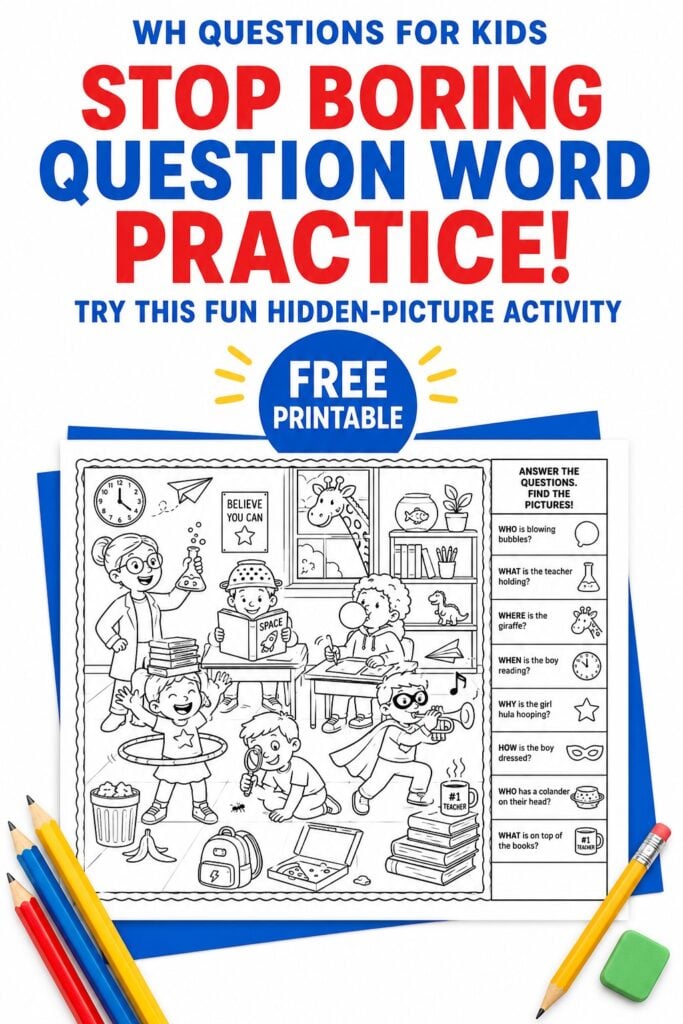
This free question words worksheet pack turns WH-question practice into a funny search-and-find activity.
Students look closely at the scene, choose the missing question word, and then find the answer in the picture. In The Wild School Day, they might spot a teacher holding an upside-down map, a student wearing two different shoes, a runaway lunchbox, and a child playing a giant ruler like a guitar. Because apparently it was a very normal Tuesday at school.
Spring activities are also a great excuse to practise language skills with these WH questions Easter printables. The themed pictures give children something concrete to talk about while they work on asking and answering questions.
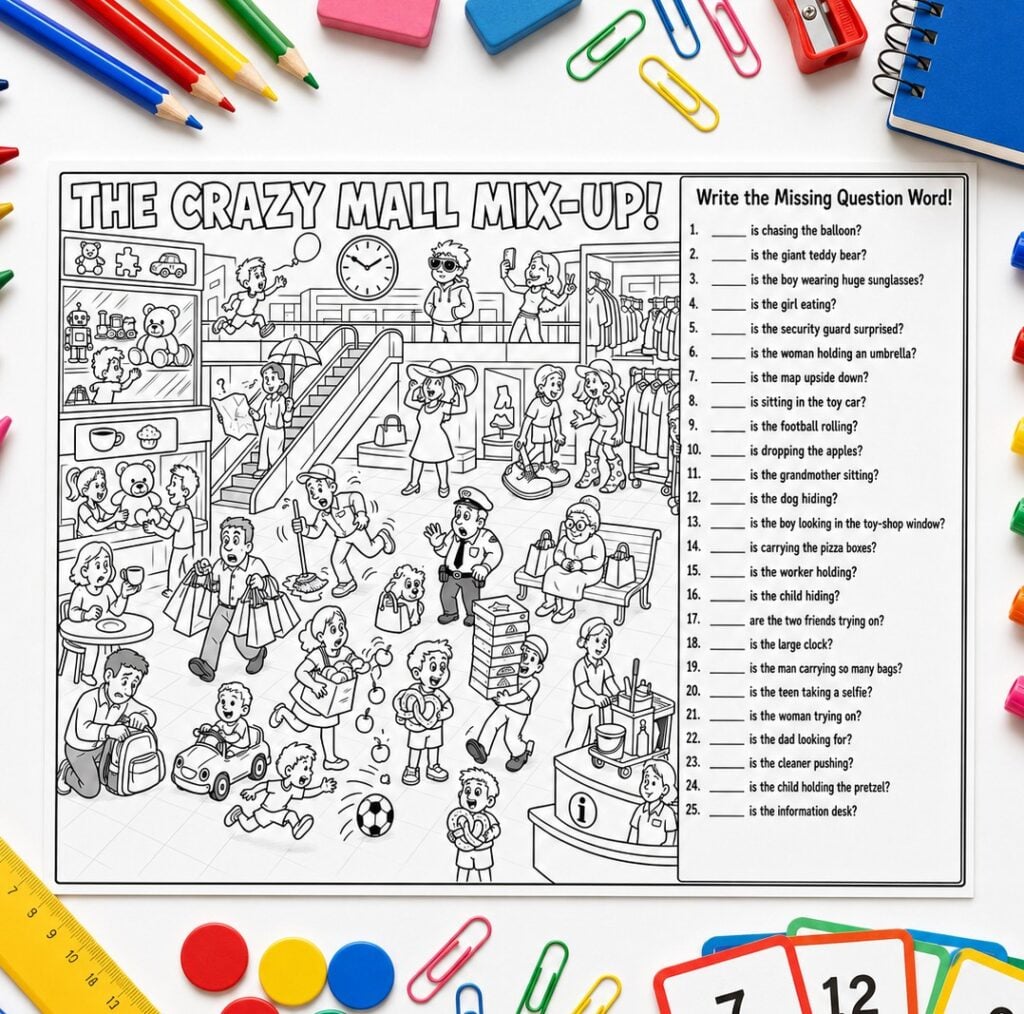
In The Crazy Mall Mix-Up, students can search for a runaway balloon, melting ice cream, a dog peeking out of a handbag, a giant teddy bear, and plenty of other silly details.
Each page includes 25 sentence starters, such as:
“_____ is chasing the flying papers?”
“_____ is the lunchbox rolling?”
“_____ is the teacher balancing?”
“_____ are the friends swapping?”
This gives students repeated WH question practice without making the activity feel like drill work. They are too busy trying to find the kid with the giant pretzel to realise they are learning.
How to Use These WH Questions Worksheets
These WH questions worksheets are easy to use during a literacy block, in small groups, or as an independent activity once students understand the routine.
For a meaningful themed activity, these WH questions Eid resources help students practise comprehension through engaging visuals and simple question prompts. They work especially well for classroom discussions, partner work, and language-support groups.
Before handing out pencils, I like to start orally. Hold up the page or display it on the board. Ask one question at a time and let students point to the answer in the picture.
Try questions like:
“Who is holding the paintbrush?”
“Where is the turtle?”
“What is the boy looking through?”
“Why is the teacher surprised?”
This builds question word comprehension before students have to write anything down. It is particularly helpful for students whose speaking skills are stronger than their handwriting skills.
After a few oral examples, students can complete the missing question words on their own. You can also read each question aloud for children who are still developing reading confidence.
These are great question words activities for:
- Morning work or early-finisher tasks
- Literacy centres
- Small-group intervention
- Homework packets
- Speech and language practice
- Partner work
- ESL/EAL lessons
- Fast, no-prep sub plans
A Fun Who, What, Where, When, Why Worksheet Alternative
If you have used a typical who what where when why worksheet, you already know that they can be useful. But sometimes children need a little more support than a list of disconnected sentences.
The hidden-picture format gives every question a purpose. Instead of asking, “Where is the cat?” with no context, children search the full scene, notice details, and find the clue. It makes the question feel like a mini mystery.
You can also focus on one question word at a time. Start with who what where worksheet practice, then add when and why once students feel more confident. For younger learners, I would begin with who, what, and where because the answers are usually easiest to spot in a picture.
Later, you can introduce when and why questions by asking students to use clues and make simple predictions. For example, “Why is the teacher surprised?” or “When might the children eat lunch?” These questions encourage a little more thinking without becoming too tricky.
If you need even more ideas for building confidence with question words, have a look at these WH questions for kids. You can mix different themed activities together so students get plenty of practice without seeing the exact same question format every time.
Turn It Into a Question Words Game
Want to stretch the activity a bit further? Turn the picture into one of those question word games students actually ask to play again.
Put students in pairs. Student A secretly chooses one person or object in the hidden picture. Student B has to ask questions to work out what it is.
They might ask:
“Who is near it?”
“Where is it?”
“What is it beside?”
“Which student has it?”
“How is the person using it?”
This is a simple way to practise question formation activities without every child needing to write twenty-five answers. It also gives quieter students a chance to rehearse questions with one partner before speaking in front of the whole class.
You can make it even more fun by giving each pair five guesses. If they cannot solve the mystery, the object remains classified information. Very serious business.
Question Words Activities for ESL Students
Visuals are incredibly helpful for question words activities for ESL students because children do not need to rely only on reading long instructions. They can look at the scene, hear the question, point to the answer, and gradually build confidence with the language.
This type of question words ESL worksheet works well because you can model just one question word at a time:
“Who is this?”
“What is he holding?”
“Where is she sitting?”
Then mix them together once students are ready. The repeated sentence structure helps students become familiar with the pattern of question word sentence starters while the funny pictures keep the activity light and memorable.
For older beginner learners, you can ask students to write their own questions about the scene. This is great for building question words exercises into a speaking-and-writing lesson without making it feel overly formal.
Great for Speech, Special Education, and Language Support
A visual question words printable can be especially useful for students who need more concrete language support. During question words speech therapy sessions, students can point to the correct person or item before answering aloud. This reduces pressure and helps children understand what the question is really asking.
The activity also works beautifully for question words special education groups because you can simplify or extend it as needed. Start with two answer choices, use a highlighter to mark the question word, or cover part of the page to reduce visual distractions. For students ready for more challenge, ask them to create their own questions from the scene.
These pages are not just a WH question words worksheet. They are a visual, hands-on way to practise listening, speaking, reading, and writing all in one go.
Tired of boring social skills worksheets that kids rush through without really thinking? This fun Search and Find SEL Book turns kindness, friendship, emotions, empathy, and anti-bullying practice into a hands-on activity kids actually want to complete.
With over 60 pages of busy picture scenes and simple real-life scenarios, it is perfect for helping children build stronger social skills without the eye rolls.
Free Question Words Worksheet PDF
If your students can recite who, what, where, when, and why but still look at a question like it has been written in ancient hieroglyphics, this free question words worksheet PDF is for you.
The printable pack includes funny hidden-picture scenes with matching question starters, so children can search, think, choose the correct WH word, and answer using clues from the picture.
It is a simple activity, but it gives you so many ways to use it: whole-class discussion, partner games, literacy centres, ESL lessons, intervention, or an easy no-prep printable for a day when your brain has already left the building.
Grab the free question words worksheet below and let your students become WH-question detectives!