Free Fix the Sentence Worksheets for First Grade [69 pgs]
A child can read a sentence aloud and still write it without a capital letter, a period, or a correctly spelled color word. These fix the sentence worksheets for first grade give beginning writers a clear job: find the mistakes and show how to fix them. If your students already use sight word sentences worksheets, this is a practical next step toward checking their own writing.
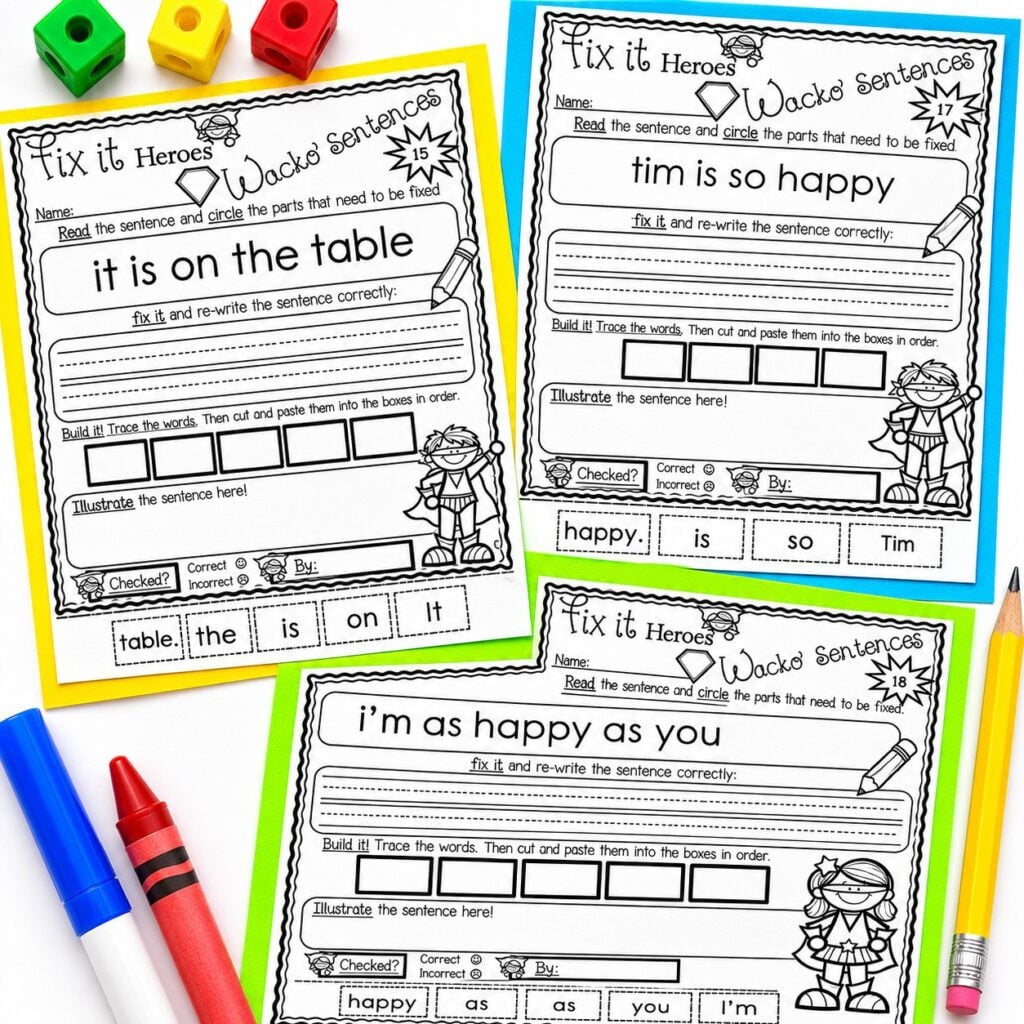
Meet the Fix It Heroes! Students read, circle errors, rewrite, arrange words, and draw. These worksheets are FREE and available in three separate printable downloads near the end of this post. There is something wonderfully motivating about being allowed to point out mistakes for a change.
What Are These Fix the Sentence Worksheets for First Grade?
This FREE Sentence Editing and Writing Fry Sight Words collection includes over 60 sentences for emergent readers and students practicing beginning writing skills. These sentence editing worksheets combine familiar high-frequency words with a repeated routine, so you can teach the activity once and revisit it with different sentences.
The vocabulary includes early Fry words such as the, of, and, a, to, in, is, you, that, it, he, was, for, on, are, as, with, his, they, I, at, be, this, have, and from. Students also practice number words from zero to ten and the color words black, white, blue, pink, yellow, and green.
These Fry sight word sentences bring reading and editing together. For additional oral practice, try building sentences with high frequency words before asking students to record them independently.
Six Stages of Capitalization, Punctuation, and Spelling Practice
Rather than starting with every convention at once, the packet moves through six groups of ten pages. Choose the starting point that matches the skill your students need.
- First 10 pages: beginning capitals. Students focus on capitalizing the first letter of each sentence.
- Second 10 pages: capitals and periods. Students correct the beginning letter and add an ending period.
- Third 10 pages: capitals within sentences. Students check capitalization at the beginning and within the sentence, along with the ending period. Discuss which words actually need capitals; ordinary words do not become uppercase simply because they are in the middle.
- Fourth 10 pages: spelling and questions. Students check beginning capitals, correct color and number words, and add a question mark when the sentence asks a question.
- Fifth 10 pages: mixed review. Students apply the skills together rather than looking for only one type of mistake.
- Sixth 10 pages: quick assessments. Students circle errors, rewrite, and illustrate without the cut-and-paste word hints.
Treat these as capitalization and punctuation worksheets with a clear teaching focus, rather than a race through the whole packet. If a student still needs help reading the vocabulary, use a few free printable sight word worksheets to revisit those words before the editing lesson.
How to Teach Fix It Sentences Step by Step
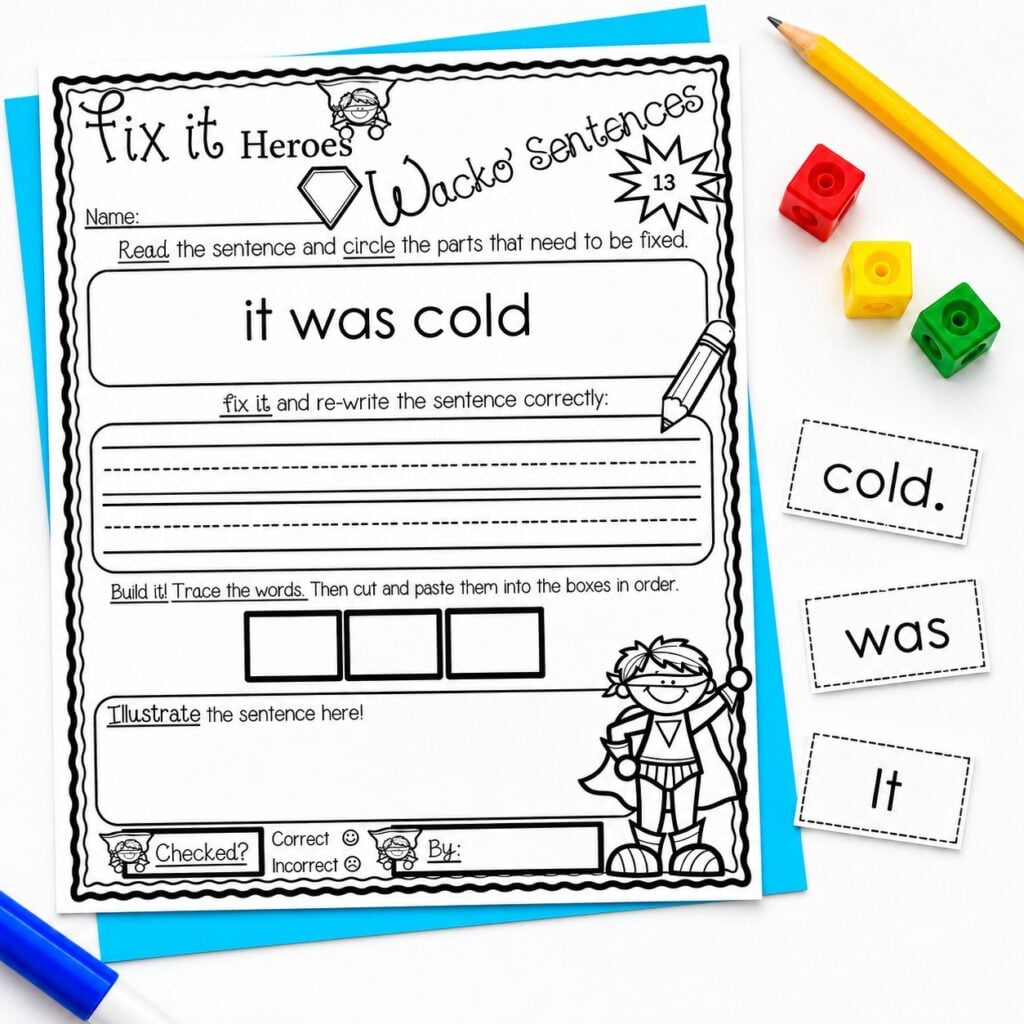
Begin with one shared example. The worksheet shown in the preview reads “they have blak coats”. Read it together, then model changing it to “They have black coats.” Talk through the capital T, the spelling of black, and the period.
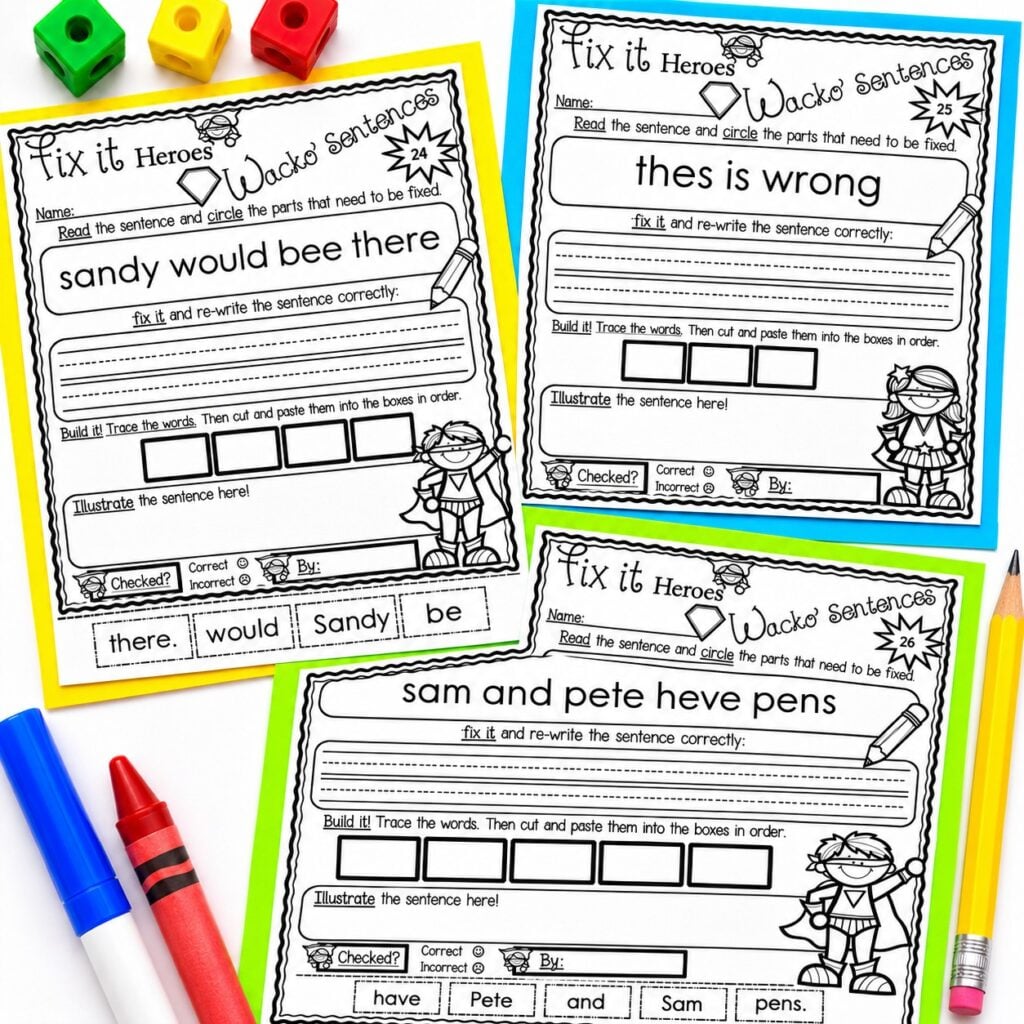
For students who need an earlier starting point, beginner sentence worksheets let them practice building and understanding a simple sentence before checking one for errors.
- Read the sentence. Point to each word and check that students understand what the sentence means. Supply unfamiliar words when editing is the lesson’s main goal.
- Circle the mistakes. Ask, “What needs fixing?” Have students explain one correction aloud before writing.
- Rewrite it correctly. Students make their changes on the writing lines. Prompt them to leave spaces and reread what they wrote.
- Cut and paste the words in order. Use the word pieces on practice pages to revisit sentence order and check the rewritten sentence.
- Illustrate the meaning. Students draw what the sentence says. For the coat example, their picture should show black coats.
Keep the routine consistent as you introduce new fix it sentences. On assessment pages, leave out the word-piece step because those hints are intentionally absent.
Where to Use the Sentence Correction Worksheets
Morning Work and Homework
After you have modeled the routine, choose one familiar page for morning work or a short homework task. Send a simple reminder: read, check, fix, and draw. Students who need easier sentence-reading practice can begin with kindergarten sight word sentences worksheets before attempting a mixed editing page.
Literacy Centers and Partner Practice
At a teacher-led center, have partners take turns explaining a correction before they write. One student can check the beginning capital while the other checks the ending mark, then they swap roles. Rotate in sentence building activities when students need hands-on practice with word order.
After correcting a sentence, reread it together with a natural voice. For a separate short reading activity, Fry fluency phrases provide another way to revisit familiar words in connected text.
Adapt the Worksheets for ESL, ELL, and Struggling Readers
For English learners, teach the meaning before the editing. Show the actual colors, count objects for number words, and let students say the corrected sentence with a partner. These additional activities for sight words for ESL students can support vocabulary practice alongside the worksheets.
For intervention or special education, reduce the task to one editing target. You might read the sentence aloud and ask the student to find only the missing capital. When teaching sight words to struggling readers, revisit familiar sound-spelling patterns and explicitly teach any unfamiliar word parts instead of asking students to guess from the drawing.
If handwriting is the main barrier, have students explain their corrections orally before writing a shorter section. Precut the word pieces when cutting would distract from the editing goal. For separate letter-formation practice, these Earth Day joke handwriting practice printables offer another writing option.
Use the Final Ten Pages to Check Independent Editing
The last ten sentence correction worksheets remove the cut-and-paste support. Use a page after teaching the relevant skills, then note which errors the student finds independently and which require a prompt.
For your own records, track beginning capitals, other required capitals, ending punctuation, and spelling separately. A student might understand periods but still need help spelling number words. Choose the next practice page from that information, rather than repeating everything.
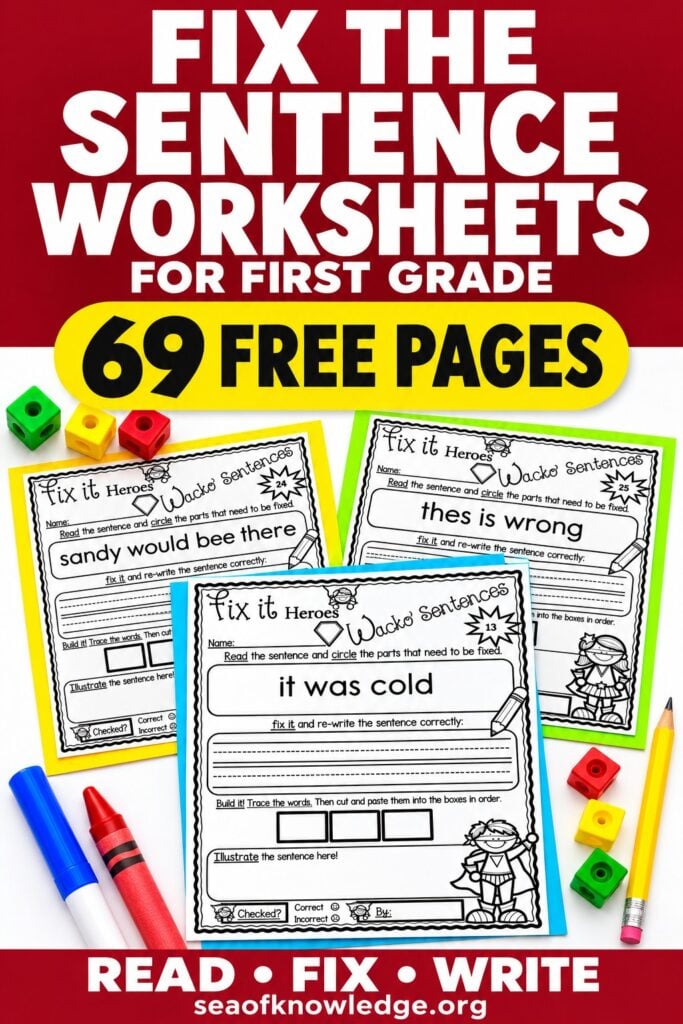
For students ready for more, ask them to explain why each correction was needed or write a new sentence using the same color or number word.
Free Download 1: Fix the Sentence Worksheets for First Grade
Download the first FREE printable set below. Choose a page that matches the editing skill your students are learning, then model how to read the sentence, circle an error, and explain the correction before writing.
Keep the first session short. One carefully discussed sentence gives you more useful information than a page completed with constant adult prompting.
This FREE 69-page bundle gives your little sentence detectives practice with capitals, punctuation, spelling, and Fry sight words. Print a few pages for morning work, literacy centers, or extra practice at home, and let the fixing begin!